All posts by dhoward@cyg.net

A Safe Haven – that makes us smarter

The new BB has hit the market — and, at least for the sake of RIM, hopefully not the deck. As expected, this newest version of the smart phone boasts all the usual bells and whistles — faster surfing, more apps with quicker switching between same, speedier downloads with a bigger screen (??) on which to watch . . And on and on. Just the candy (again, hopefully) for this sugar-starved population. Slowing down, doing less at one time is becoming an increasingly hard sell in this world.
I had occasion to read John Allemang’s editorial in this weekend’s Globe and Mail, Psyched in the City, and was reminded, yet again, just how vulnerable we are to such appeals as the new  BB Z10 and all its wonderful ‘capability’. The column considers our essential neurological inclination to soak up as much information, input, stimulation as we can — up to a point! The research he reviews suggests that, historically, this has been a good and adaptive thing. In past times, when things were so much simpler — but arguably more precarious (no sabertooth tigers around the neighborhood last time I checked) — it was important to be vigilant and to process as much information, central and peripheral, as possible. Our safety depended on it. Evidently not so much anymore — and it’s not just the drop off in the tiger population.
Allemang identifies another trend, the increased congregation of folks into more concentrated geographic pockets — aka, cities. Our hungry little brains now have just lots and lots of stuff to absorb. So much so, that another evolutionary trend has been identified: our brains are also becoming rather selective — once we hit info-max! In everyday talk, this translates into our innate ability to focus on a specific task, shutting out what the brain considers extraneous or irrelevant. Otherwise we’d all be reaching for the Ritalin and bouncing off the over-stimulated walls of the attention deficit disordered.
That’s the good news. The bad news, to quote Mr. Allemang is that ‘cities take distraction to a level undreamed of on the primeval savannah, to the point where the urban form itself can be blamed for messing with our minds’. In other words, an uncritical reliance on our own built in filters — to shut out the irrelevant in the over-busy, over-stimulating environments that our urban environments increasingly represent — is no longer sufficient. In fact, it can get us into serious trouble. He cites the almost cliched example of driving in city traffic while checking our incoming voicemail / texting. The brain, ever dutiful, is very likely to interpret the driving part of this scenario as the ‘irrelevant’ piece, the ‘urgent’ response to a changed lunch date in one’s inbox as the more central, focal task. Oops.
And cultivating a multitasking skill set is not the answer. In fact, once again, this much touted (and now increasingly fueled with the advent of newer, faster, more multi-tentacled toys) capability simply does not exist. What does exist is our capacity to switch quickly between tasks — provided the choices are contained to a reasonable number. Beyond that limit, it’s ADHD time folks!
And so our choices. A place in the country. Perhaps. Or quite possibly a place in the city (actual or metaphoric) that gives the brain a rest. Additional research supports the view that breaks in low-stimulus zones — I think we call them parks — not only gives the brain a chance to relax and restore creativity, but it also is likely to improve our memories and equip us to pay more productive attention once we return to the war zone. The metaphoric equivalent of going to the local green space, of course is a regular mindfulness practice. Short of entering an immersion tank, the skill set that such a practice cultivates is exactly the ticket: one-pointed focus (in an environment where it won’t lead to a close encounter with a telephone pole), reduced stimulation (only the breath), and a chance to turn off the smart phone.
Image from Globe and Mail, Mcleodwoodside.

Polarities

When people see some things as beautiful,

            other things become ugly.

When people see some things as good,

            other things become bad.

Difficult and easy support each other.

Long and short define each other.

High and low depend on each other.

Before and after follow each other.

Ch. 2, Tao Te Ching, Lao Tzu; Trans. Stephen Mitchell

A natural human inclination is to think of things in pairs. The preceding meditation from Lao Tzu’s wisdom, however, describes another human tendency: the attaching of a value or judgment to these pairs — one side characterized as ‘good’, the other ‘bad’.  Or more properly, when we attach a value to one element, by default, the other assumes its opposite. Even the Taoist graphic above tends to elicit this bias: light (good) / dark (bad); yin (compassionate, flexible, patient — good) / yang (aggressive, rigid — bad); female (‘good’)/ male (‘bad’).
The second portion of this quote attempts to describe a ‘healthier’ perspective. In place of judgment (of one or the other), we are encouraged to explore the relationship between, the existence of one’s dependency on the existence of the other, the natural (and necessary) sequencing or cycling of events, their temporal harmony. So common as to almost be cliched, we check the weather in the morning; and are pleased to see a warm, sunny day in store with a light breeze and low humidity. The prospects of a rainy, cool forecast, with winds from the East — well, not such a happy prediction. But then where would we be with only the former. . . and none of the latter? It seems that the real trick is to establish a posture that values, accepts, and welcomes the current state — since we seem to have very little choice over it anyway! 
As usual, a couple of conversations. The first with a neighbor I’d not seen for some time, she just having returned from a four-day, solo retreat in an idyllic spot on Lake Huron.  We met in the late evening street, walking our respective dogs. I was feeling cold and tired and a little resentful that our one Westie was doing her usual delaying tactics; the other two were worrying our neighbor’s dog, five times their size and rather bemused by the whole exchange. I made a comment about ‘hating re-entry’, a reference to the transition from a period of blissful solitude and reflection to the urgency and ‘noise’ of the day-to-day routine and demands — very likely a projection of my own past experiences. Our neighbor, not unlike her dog, seemed a bit bemused by my (evaluative) comment, considered it for a moment and replied that ‘it is what it is’ (the ‘it’ being the present circumstance). I had initially considered my comment to have been an expression of some sympathy and support for what I’d assumed to be a surrendered state of peace and insulation from the busy-ness she was about to re-engage. I was reminded, on reflection, that I’d done precisely what Lao Tzu warns of: celebrating one state and, by extension, denigrating, debasing another. The alternative: valuing, accepting both — for what they are.
On a semantic level, a conversation with my wife triggered a similar awareness. She and her instructor in Alexander Technique had been discussing what she considered to be the guiding principals of this approach: Inhibition and Direction. Again, my subjective response, my associations, particularly to the first of these is, well, negative. Years of psychology linking inhibition with repression, forced containment of instinct, etc. had jaundiced things for me. And I was reminded how easily we apply a value. In practicing the technique, which in my elemental understanding, has a great deal to do with cultivating an awareness of body posture, then ‘directing’ oneself to adopt an appropriate and helpful orientation, one must ‘inhibit’ counter productive postures to enable healthier ones. Hardly a negative act.
Action, reaction. Sympathetic, parasympathetic. Flexion, extension. All paired, all intimately bound to each other. Not a ‘good guy’, or a ‘bad guy’ amongst them.
A large part of mindfulness teaching is based on cultivating a balance in our day, in our views, in our attitude. The wisdom is contained in the concept of equanimity. In brief, this is the practice of accepting what comes with a calmness and a composure, with a nonjudgmental perspective; the capacity to consider the ‘polarities’, extremes, or opposites from a balanced point of view — without attribution, without assigning a ‘valence’.
That this wisdom has practical value is underscored for me almost daily as I review the basics of cognitive behavioral therapy with individuals struggling with anxieties and mood issues. The approach espouses very little different than adopting an equanimous view of circumstance: collecting ‘data’ for a variety of interpretations, or ‘automatic thoughts’ — those which both support and challenge the (reflexive) ‘hot thought’; all with the same goal — developing a more balanced view.

Choice

The following piece is not about mindfulness. It was, however, precipitated by a conversation, two actually, about same. The first, a short one, with my wife, following her (usual) proofing of such writing. ‘That’s pretty grumpy’ in summary comment — and ‘where’s the connection to mindfulness?’ The second was with a zealous young man, fresh from a frustrating confrontation with an institution which, in place of accommodating him, had chosen to ‘apply the rule book’. In need of grounding, we discussed and redirected. From reactive and impulsive action to alternatives. From impugning the ‘opposition’ to an understanding of the position occupied by the ‘down on a lower rung’ foot soldier with whom he’d been dealing. From immediacy to patience. From blindered vision to perspective. From reflex to intention. And, deciding if ‘this is the hill I wish to die on’ — picking his fights. Hitting the pause button and becoming self-aware. This piece, then is my. . .
Choice
So how do you kill a rat — or at least turn him (females deal much better with ambiguity and lose/lose situations than guys, regardless of species!) into a hopeless neurotic? Simple. Create a prohibition with no reasonable, alternate choice. In B.F. Skinner’s laboratory, this might have looked like posing the ‘choice’ of pressing a bar to get food; and, in the bargain, electrifying the floor on which one is standing. Do what’s good for you and what’s bad — all at the same time. Hmm?  As the good Dr. Skinner discovered, in the short run, you get a really confused rattus norvegicus; long term, one with tummy ulcers and. . . Or you could just plunk him on a bicycle in and around Stratford.
So, when the invite to join the incipient Stratford Bike Club arrived in the in-box, I had a careful look at the ambitious scope proposed. Laudable to be sure: raising a cycling consciousness in the community, arranging rides, disseminating information on safety, rules of the road, bike repair, liaising with area cycle clubs. Open to all ages. As a veteran rider (7000 K logged this year), cycling advocate, and longtime member of the former and now formally dissolved Festival City Cycle Club (insurance premiums became prohibitive), — a free Big Mac and spare inner tube to the first person who can name the designer of the club’s logo* — the mandate had a familiar ring to it. Back in the day, it only made sense to promote all these sensible and appealing benefits of two-wheeled transport: community-building, environment-saving, health-enhancing. An absolute no-brainer. Evidently the siren song persists. Been there, done that — and frankly still own the T-shirt.
The hiccup, then, as now: Stratford, as a political and committed community of motorized, four-wheeled citizens, we’re not really interested in supporting those weird folk that trundle about on bicycle, blocking our right of way, and who generally don’t act their age. Bikes, like Trix, are for kids, right?
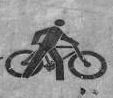
Strolling along our main drag, you may have noticed a creative bit of iconography making an appearance over the past year or so, not unlike the image at the left. I, like you I expect, and always assuming you own a bicycle, made the purchase with the expectation of riding (i.e., not walking) it. If I’d wanted to walk, pushing an awkward, ungainly thing along ahead of me, I’d probably have invested in a shopping cart. But as a respectful citizen whose mom raised him up good, I am content to acknowledge that sidewalks are (as the word implies) for walking — not riding. The riding part should take place adjacent to that part of the landscape starting with ‘side____’ — again as the word and icon suggest.
Now glance to your left (or right, if you happen to be walking east on the north side of Ontario St. — and if you’re looking in the front window of the Milky Whey, you’ve got it backwards). No, beyond the string of parked cars — all the way to the four lanes of traffic, politely populated with eighteen-wheelers and sport utes. And cast your mind back to our confused brown rat. We want to do our ‘green’ bit, reducing our little part of the carbon footprint. We want to promote a healthy lifestyle, support new club spirit. These would be the ‘good’ things associated with pressing the little bar in Dr. Skinner’s box. But each time we do so and dutifully receive our food pellet, we get that old jolt from the cattle prod. Who knew that our pedals and bike seat were installed by Ontario Hydro? We’re provided the ‘choice’ of getting ticketed for riding in the relative safety of the sidewalk or getting honked at, cursed out, or merely squeezed into the side of one of those parked cars. Ah, the joys of choice.
Oh, I have some solutions — bit radical perhaps, but solutions nonetheless. Perhaps we could begin by providing a viable option to the ‘don’t ride here’ interdict. Stratford’s current idea of a ‘bike path’ is to build this town’s equivalent of the Allen Expressway — essentially a road to nowhere. (For those of you that may have missed it, the most glaring albatross runs along the northeast culvert of Gibb Rd. –aka, line 29 — for one kilometer between Hwy. 7 and the rail line; happily ending in a deadend.). The Brits seem to have this sorted quite economically in high traffic areas by demarcating sidewalks much as we do our roadways: one side of the line for pedestrians, the other for cyclists.  Then there’s the old fashioned idea of painting cycle lanes on existing roadways. And perhaps the most radical of all: turning the downtown core into a pedestrian / cyclist zone.
I fear, however, we may be dealing with a situation akin to that famous lightbulb — you know, the one that’s burned out and is in need of changing by a fleet of psychologists. It only takes one of that fleet to change it — but the bulb has to want to be changed.  Until I stop feeling the zap of the cattle prod in my chamois, I’ll just keep a low profile in the country and tend to my nest of neurotic, ulcerated rats. Picking my spots. Acting with intent. Om.
*Answer next week