Going Cross Country (1991)

MUD!! Salons smear it on their customers’ faces—and youth is restored.  Johnny Cash mixed it with blood and beer and rekindled his relationship with father.  Kids bake it.  Potters shape it.  Shamans cure ills with it.  What marvellous stuff!  Surely it be magic.

            In case it escaped your attention, your average road racer is something of an intense character.  The speed work, the frustration of the year’s goals unrealized, the summer’s heat; who knows what the equation contains.  The sum is always the same: a runner with sore joints, a full log—and an attitude.  Take a look at the start line faces come September.  Not a happy lot!

            Well folks, I’m here to tell ya that the cure ain’t to be found in a Runner’s World diet, another “fool proof” training schedule, or visualization.  It’s MUD!  I’m forty-three and I use it to cleanse my runner’s soul each Fall.  Now I’m not going to go all quasi-philosophic or white-suit preacher on ya—although, for a $5.00 donation, I will send you a 100% guaranteed starter kit of your own (just add water and stir).  You don’t have to coat your body in it, eat it, heat it, or electrify it.  You just have to stand in it.  Yessir! I’m talkin’ muck, and that rhymes with _uck and that stands for FUN!

            What a ludicrous idea.  Having fun running.  Where’s the competition?  The thrill of victory (or more commonly, the agony of defeat)?  The $3.00 medal or the “Certificate of Participation”?  Tell the truth folks, they ain’t there.  There’s just you, a few dirty friends, and nature.  Pretty weird, eh?  Well, hear me out and, if not fully satisfied, toss me on the pile of used snake oil salesman and go back to your hard, cold asphalt.

            All right.  I confess.  It’s not the mud that heals—it’s Cross Country running.  Several years back, a well-meaning acquaintance suggested that, in place of the usual “Sunday long one”, we go for a trot over at Wildwood, our local Conservation Area.  Understating it, I was appalled.  Did she know the distances (measured to the nearest centimetre)?  How ’bout time?  Could she guarantee hitting target heart rate?  And the fragile ankles—on the roads, pebbles the size of peas raise the spectre of sprains and tears.  What would sole-sucking, tendon-twanging sink holes do to this frail frame?

            My friend adopted that kindly, patient posture reserved for wizened sage – airhead apprentice chats and explained that this was not about speed or killer aerobic pace.  It was about enjoyment and recovery.  Leave your watch at home, slip on these spikes, and try not to stab yourself getting out of the car, was all she’d say.  I was not convinced.

            I had been in the country before.  I live in the country.  But I most certainly had not run in the country—at least not without benefit of road signs, pavement, and a clear view of the next ten feet of route.  I’m not exactly the kind of person who gets lost coming out of a subway station—but neither am I Daniel Boone.  How was I supposed to know where I was going on these path things that she proposed following.  Why, in some places there were just trees and bushes; no arrows or signs warning you off a twenty-foot precipice.  Again, the patient reply: follow the orange blazes.

            Well, I don’t know what kind of twisted sadist marked the trails at Wildwood in orange, but he surely did it in high summer or the dead of winter—when your ubiquitous stands of maple trees were either green or leafless.  Let me tell you how hard it is to pick out a sloppy splash of orange paint on a tree resplendent with Autumn colour!

            Good ol’ Acer saccharum (that would be sugar maple, for those of us without grade 10 biology) is not the only bit of flora to be found in this woody wonderland.  Burdock thrives as well and, according to my daughter’s World Book Encyclopedia, is known to be “troublesome¼it’s seed heads stick(ing) to the hair of cattle and sheep”.  News flash!  It sticks to human beings clad in spandex as well.  This may have been the stimulus that prompted some creative Frenchman to design the prototypical Velcro fastener—but I don’t necessarily want to return from my runs looking like some cowboy wearing hairy chaps.  (The sage’s advice: “ditch the tights”.)

            Among the more attractive parts of my friend’s sales pitch was the solitude offered by our scheduled commune with nature.  This would certainly be a welcome switch from the all too familiar struggle to stake out one’s turf on city streets.             No dogs, no irate motorists, no head-down commuter cyclists.  All true.  In fact, if you haven’t had your monthly existential panic, try inducing it by running alone in the woods.  One’s mind starts to play subtle little tricks—like my flashback to Mirkwood.  Sure, to the casual observer that dense grove of spruce may be just another clump of conifers.  To the edgy, citified runner it bears an uncanny resemblance to the legendary home of Tolkien’s Orcs and Great Spiders.

            Neither is this to say that the only fauna to be found in them thar woods is imaginary.  At least I think that clutch of round-faced boy scouts we surprised, mid-breakfast was real.  Certainly the sounds of scout master Bob trying to restore the sense of blissful isolation and “roughing it in the bush” for his boys—so rudely intruded upon by two runners in red tights—could be heard far down the path.  But then I wouldn’t want to sell short the hallucinogenic powers of the place; after all it was Wildwood.

            But I digress.  We did emerge at long last—burdock pom poms where our shoe laces had been; brackish, black gunk oozing out around our ankles (oops, sorry, those are socks); and mud (magical mud) from head to heel.  Miraculously, no broken bones or twisted ankles (although my hamstrings did feel like someone was beating on them with a five pound sledge).  And best of all—I felt marvellous!  Positively rejuvenated.  I looked over at my friend and (from what I could see of her face), she was smiling.  And so was I.
1990’s

Writing, whatever the quality, has a rhythm to it. It reflects one’s place in the world, one’s relationship with that world and attitude towards it. It may point to ‘what matters’ — bound by the particular age and stage of the time. It pulls the curtain back on obsessions, opinion, assumed absolutes. If the writing is honest, it can be a mirror of the personality.

It’s coming up on Christmas 2024. A time for reflection on the year lived. And, as it turns out, a bit more of a retrospective look. At the time the pieces that follow were penned, some now nearly four decades ago, the edge, (along with the vitality!) very much defined. The certainty, the readiness to pronounce, held sway. Many were written as monthly editorial contributions to a running club’s newsletter. Many more from a similar attachment to a cycling circle, connection to which would span three decades. . . and the unimagined changes that would hold sway over mid-life and beyond.

And so. . . the 1990’s.


Big C

We three jogged out of the parking lot of at a local conservation area, single-filing it onto a narrow track. The eight or so kilometres of trail led around a man-made lake that, for southern Ontario, boasted surprisingly woodsy surroundings. Normally full of day hikers and kids — this was late September, the kids were back in school, and we had the route to ourselves. What we also had were wet, muddy, now overgrown pathways . . .and slippery footing.  

There was a time when the trip or slip was just a predictable part of these slick runs. Getting dirty was part of the fun. We all took pride in the shoulder roll after a tumble — landing back on one’s feet, barely missing a stride. Fall was a season — a noun, not a verb. 

A few decades on, and hurrying along the icy, January sidewalk — late for an opera in Toronto’s downtown, it became a verb. Flat-out face plant — well more a knee scuff — but shame-worthy nonetheless. Then the streets of Venice, and racing to catch a train, the cobbles had their way — twice actually. A pattern was starting to emerge. I’ve never been a clumsy guy. But. . .

“Well it’s not Lou Gehrig’s.” Hard to know what passes for reassurance in the hallowed hallways of internal medicine. The conversation continued on for a bit, with a few other ‘rule outs’, working its way toward a ‘probably. . . but won’t know for sure without a biopsy’. And wrapping up with a ’95% certainty’. Aside a stubborn case of acne as a grade niner and a need to shop in the ‘husky boy’ sections of Eatons, I’d entered the world of real medical stuff for the first time. The acne went on its way, a compulsive running routine and a pay check to pay check budget transformed me into the ‘skinny dude’ — but this other. . . well, it was here to stay. 

I’ve had a, let’s call it, ‘atypical’ relationship with urology. Working in a general hospital setting for 25 years in a community that could generously be called a ‘small city’, I knew most all of the docs. At the time, that meant having a nodding acquaintance with the town’s only such specialist. Highly eclectic guy who played jazz guitar as part of a pick up band on the main drag on weekends — then did, well, what these guys do to put bread on the table for the rest of his week. 

Abiding memory of dealings with him professionally was that of a Friday afternoon check in to get vasectomized in my late thirties. Not sure how these things happen nowadays, but it used to be a local anaesthetic — and the opportunity to gaze up at the (clinically dispassionate) faces of doc and nurse assistant. It also left one fully able to ‘eavesdrop’ on the banter passing between these two. Jazz was going to be forestalled in favour lint rollering the new, red velvet couch, cat’s hair being the iron filings to couch’s magnet. Not sure I actually voiced the thought, but could you two maybe just focus on the job at hand (as it were) and plan the weekend later? Suffice it that these prior urological dealings had a bit of a twinkle and chuckle associated. Snip, snip and no heavy lifting for 24 hours. 

What you don’t know, can’t hurt you, a rework of the sixteenth century aphorism, comes undone with distressing frequency as we tack on the decades. So this was the year to uncross the fingers and ‘get checked out’. What’s PSA and, more to the point, what does a reading of 14 mean? Evidently it means ‘go see the 2024 version’ (of the jazz playing, cat owner). So, having assumed the position, the cryptic ‘Hmm. . .’ that followed begged a little broader explanation. ‘Feels normal’ was the ‘full version’ — along with a bit of relief (for any number of reasons) — but also accompanied by a post-it note with a date for a biopsy! Seems ‘normal’ has a different connotation at 78. 

To frame the current iteration (of urologist) as a man of few words is understatement. Biopsy done, complete with a dozen or so needle jabs in the gland of interest, the call came from, we’ll call her Melinda whose resume is more about short skirts and obedience: ‘David dear I have your results. . .’ Turns out it’s a bad news, good news scenario: cancer, but contained and Dr. T (for taciturn) would like to review.

As Dr. T proceeded to rule out a variety of options — all reserved for ‘younger candidates’, he gave the Reader’s Digest version of treatment: essentially radiation (I had a choice of ‘high’ or ‘low’ — another ‘hmm’, this time on my end) coupled with ‘hormone therapy’, the euphemism for triggering male menopause. Turns out prostate cancer cells snack of choice is testosterone. So, ipso facto, starve the little buggers by changing their diet. A second post-it note was the where and when all this would happen: London’s oncology clinic (because ‘that’s where we refer’). 

I’ve gained a new respect for Nicola’s capacity for self-regulation over the past several months. London Health Sciences is roughly twice the driving distance as Kitchener’s equivalent facility, the Grand River Cancer Care centre, a consideration when the plan involved daily trips for multiple weeks. And Dr. T’s ‘review’, generously, could be called succinct, the information formatted to fit the ten minutes allotted to providing ‘answers’ to next steps, etc. etc. 

Nicola maintained composure throughout the drive-by appointment, neither speaking nor pulling out a sidearm. She was merely going to leave, do the research — her ammunition for the metaphoric Glock — and formulate the actual plan. Suffice it to say the Rottweiler had been awakened. 

Two timely and highly clarifying oncological consults later (at Grand River!) — offering a full palette of treatment choices (despite my advanced age!) — I was slated for a pre-op intake. A couple of servings of my favourite vintage (Pico-Salax, straight up) with a side order of tea, jello, or (living on the edge) popsicles would see me prepped for an extended ‘nap’ the day following with all the other post-surgical niceties.

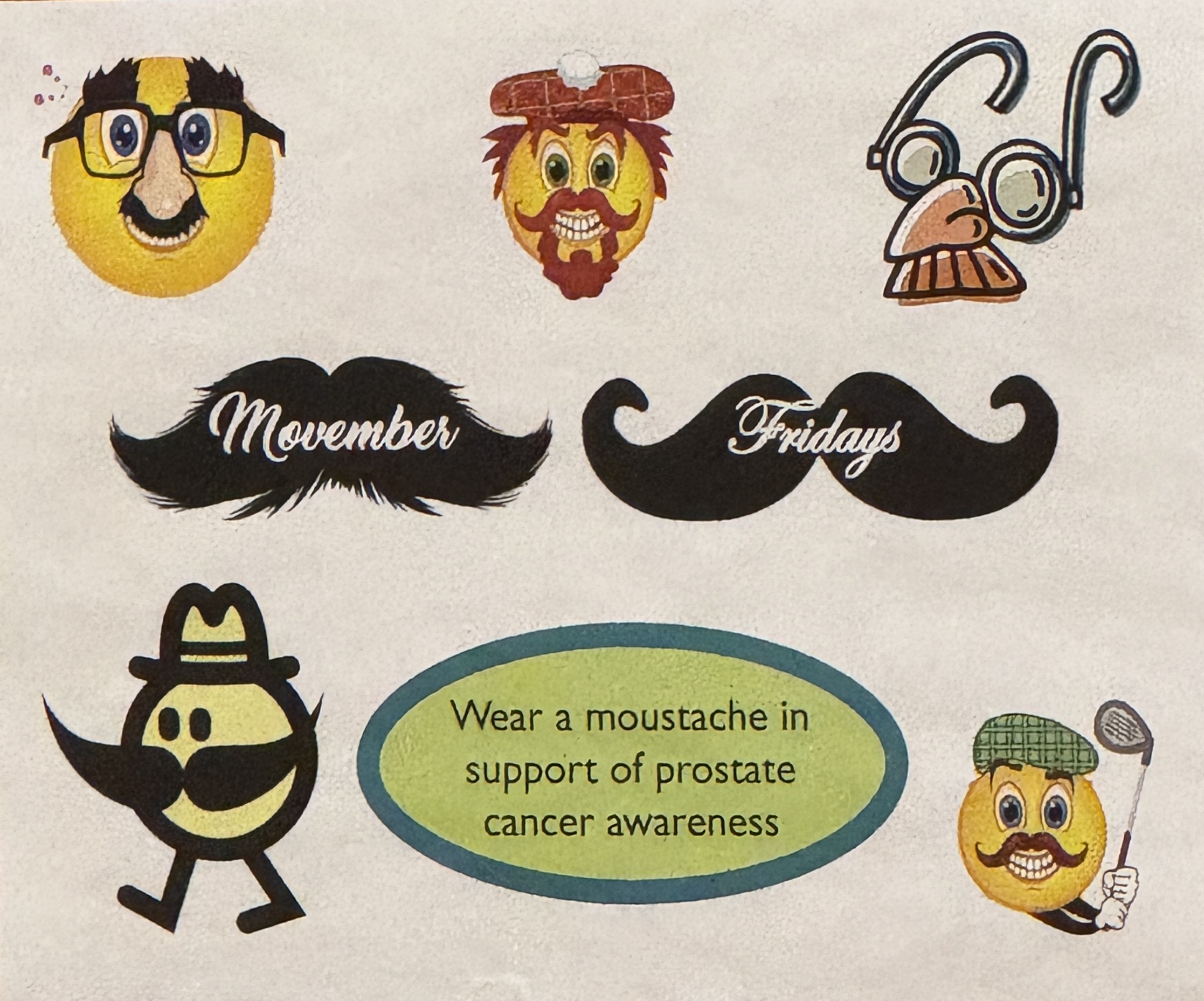
Brachytherapy, the procedure that would happen while I was sawing logs, sounded a bit like surgical alchemy — literally turning one’s prostate to gold — if only briefly — before  the haul is reclaimed and sold back to the local jewelry store (the gold, not the prostate). In my layman’s terms, it was a combination of salting a claim (sprinkling just enough gold seeds to get the interest of the assay office, aka radiological wizards) and an afternoon-long game of Minesweeper. The ‘treasure map’ in this case identified the ‘dig here’ sites for said salting, a quick zap, then reversing the whole thing — all hopefully without setting off any ‘explosions’. Happy to have been asleep throughout! The irony of all this was not lost on me: the eve of my 78th, election day in the US, and Movember to boot! 

Day surgery being what it is (day surgery), a post-procedure visit from surgeon and anesthetist, staff reassurance that I could actually pee ‘successfully’, and we (Uber Nic, as she would become over the ensuing three weeks and I) were headed home. Side bar: the sleep doc, I’d say, at a guess, my age peer, had offered his version: ‘long, bit boring procedure’ . . . seems boring translates into lots of sitting around as the surgeon does his video-gaming magic (and obviously preferred to complicated, or exciting), long being shorthand for his second such four-hour shift of the day.  

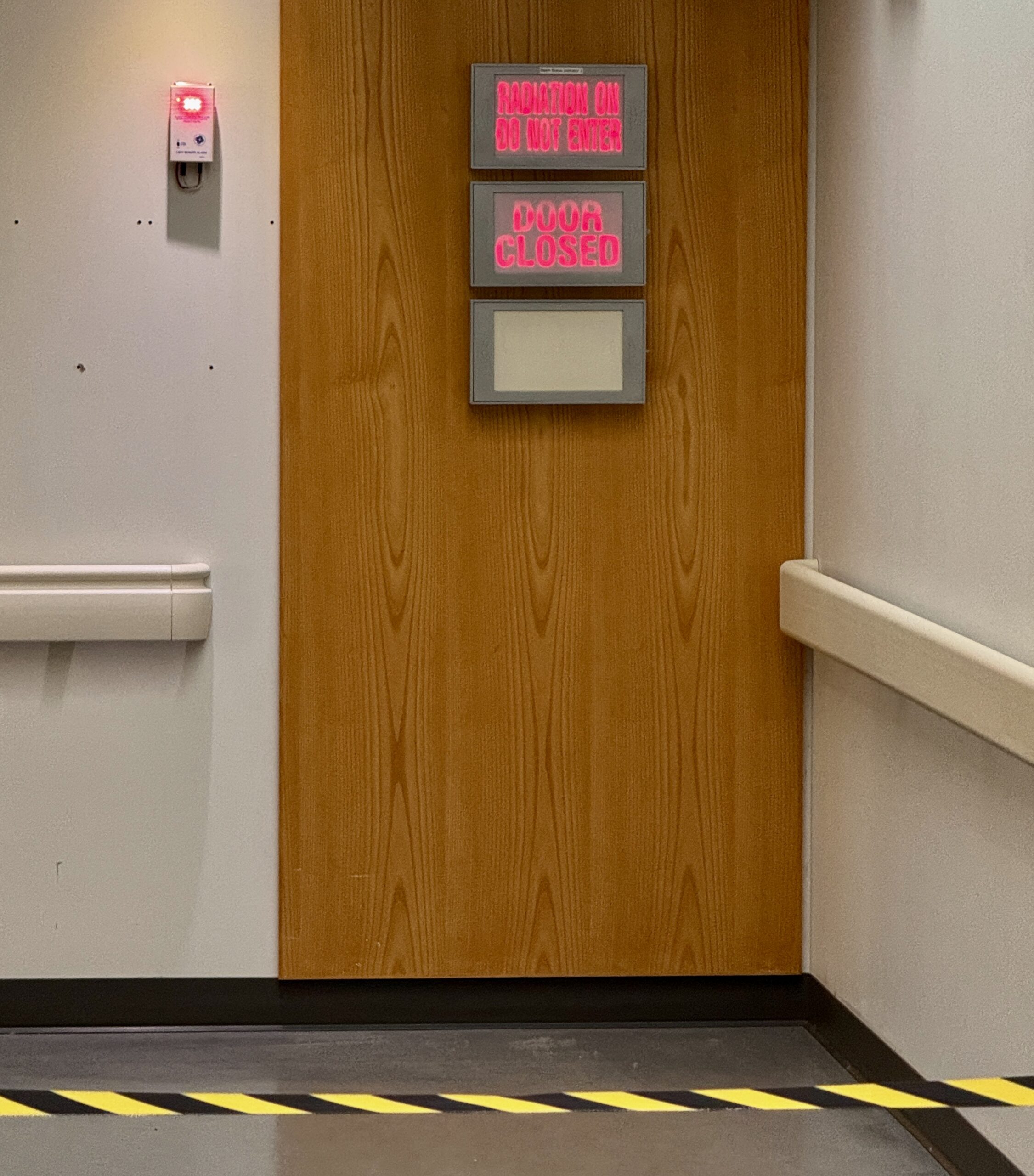
And so commenced ‘the drill’ and a surprisingly intimate connection with Waiting Room ‘C’. What begins with a visit to Grand River’s ‘tattoo parlour’ and all the uncertainty of first steps into unfamiliar territory, gradually morphs into a comfortable (or at least, familiar) routine, repeated daily, briefly, painlessly — supported by a dozen or so dedicated folks, from volunteers to  nurses to technicians to specialists . . .and, of course, the ’customers’. What could easily have become a clinical, insular, dehumanizing regimen to be tolerated became a profoundly human experience — and the opportunity to connect, albeit fleetingly, with a cross-section of folks joined by a single, common thread.

Welcomed on arrival by one of an amazingly available (and legion) coterie of volunteers — B____ as it turns out is a neighbour — always smiling, polite, and ready to direct as needed (and it was needed early days!). Technicians to a one introducing themselves, offering a bit of banter that would likely be repeated a dozen times or more as their day unfolded, and the unfailing query (‘drink your litre?’) — helpful, supportive (literally), and ever respectful as they lined up the three little tat targets for a ‘clean shot’. The twice clockwise, then counter revolutions of magical, mysterious ‘barrels’ of equipment, carefully compliant with the directive to ‘not move’, caught in the crosshairs of the green laser beam. Then, the dash to jettison the liquid preload!

One of the most abiding memories of these three weeks is of the occupants of Waiting Area C. I’ve spent time in the anterooms of enough professional offices over the decades to establish some expectations of what passes for defining demeanour: vacant, averted gaze, phone scrolling or disinterested magazine page thumbing, awkward, nervous silence, each content to remain isolated in ones own wee bubble.  

Not true in ‘C’. The encounters had a kind of rhythm about them. Perhaps, with repeated meetings, a shared ‘reason’ for being there, the brevity of the contacts (15 minute ‘commando raids’), and a certainty about the upcoming ‘procedure’, the ice was broken in some unspoken way — and we were all free to engage and share. Too, this was an astoundingly eclectic group, testament that cancer plays no particular favourites. The Amish farmer, the airport security guard, the retired university professor, a contractor, a dreadlocked sometime hippy — some accompanied by partners, some on their own. Where one would expect a dour mood, the conversation was invariably (and, I believe, authentically) positive. The nod of acknowledgement as a familiar face entered; the congratulatory moment when a treatment cycle was nearing completion. The little ‘club’ that required no additional explanation, no elaboration. 

So did it all work? To quote a friend: ‘ask that question in another five years. . . and then we’ll know’. For now, suffice it that this very significant part of our medical system,  membership, and community does work. . . and very well indeed.